 PupShift
Shared dog custody: a schedule and handoff plan for two homes
In short
First ask whether two homes suit your dog at all. If they do, choose longer stretches over frequent swaps, keep the routine the same in both homes, make handoffs short and calm, and keep one shared record of meals, walks and anything the other home needs to know.
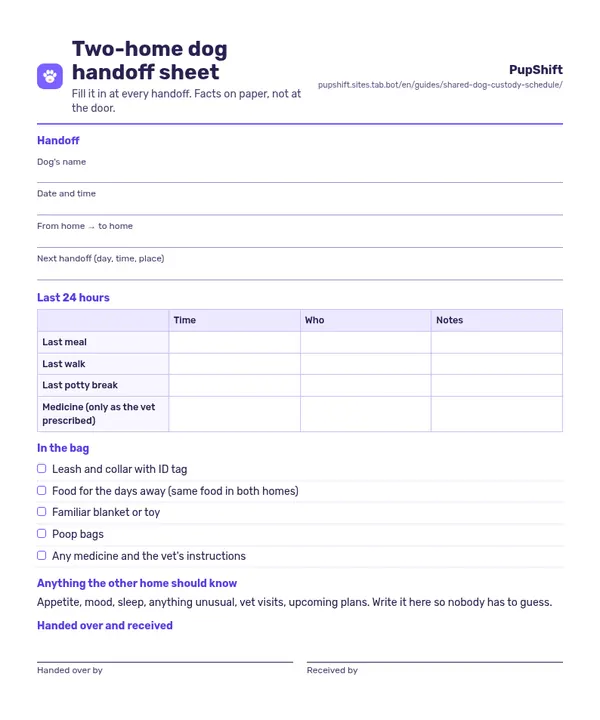 PDF · A4Two-home dog handoff sheetDownload PDF
Sharing a dog between two homes can work, but it works best when it's planned around the dog rather than around who "wins". This guide is for separated couples, divorced parents whose kids move between homes, and friends or relatives who co-own a dog. The example: Pepper, who splits her time between Dana's apartment and Ron's house, with their kids Noa (11) and Ari (7).
This is a practical plan, not legal advice. If you're writing a formal agreement, a family lawyer or mediator can tell you how pets are treated where you live.
Decide if sharing suits your dog
Start with the honest question: is two homes good for this dog? Karis Bryen, a dog behavior consultant and family mediator writing in the IAABC Foundation Journal, says shared custody is rarely the best option for a dog, although many learn to live with it. In her experience it's most likely to work with younger, well-adjusted, confident, easy-going dogs, while rescue dogs, toy breeds and older dogs often struggle with two homes.
She also points to the people: if every handoff is angry, that isn't fair on the dog. After you start, watch how your dog handles the switches. If they seem unsettled or stressed, talk to your vet or a qualified trainer, and be open to changing the plan, including one main home with visits.
When there are kids, the dog often matters even more. OurFamilyWizard quotes the same kind of advice from Karis Nafte, a pet custody mediator: if the dog is very attached to the children, moving back and forth with them can work well. If the dog is strongly bonded to one parent, it may be fairer for the dog to live with that parent full time.
Pick a schedule with fewer switches
Fewer switches usually means less upheaval. Bryen suggests longer periods with each person rather than shorter ones, and says two weeks or even a month on and off often work well.
Common patterns:
| Pattern | How it works | Good when |
|---|---|---|
| Follows the kids | The dog moves with the children's schedule | Kids and dog are very close |
| Long blocks | Two weeks or a month in each home | No kids, or kids are older |
| Main home with visits | One home day to day, set visits at the other | The dog finds change hard |
| Main home with cover | One home, the other covers trips and busy weeks | One person travels a lot |
Whatever you pick, write down the exact handoff day and time, and what happens on holidays and trips. "We'll figure it out" is how arguments start.
Keep the same routine in both homes
The American Kennel Club's advice on routine changes applies here: dogs feel more secure when they know what to expect, and when one thing changes it helps to keep everything else the same. So agree on the basics once and use them in both homes:
- Meal times and the same food. How much to feed is a question for your vet, and both homes use the same amount.
- Walk times, roughly, and the same house rules (couch or no couch, where she sleeps).
- The same words for the same things: "sit", "wait", "go potty".
- A familiar bed, blanket or toy that travels with the dog, and basic supplies kept in both homes so the bag stays small.
Make handoffs short and calm
The handoff is where most friction happens, so make it boring:
- Same day, same time, same place every time.
- Keep it short. Pass the leash, the bag and any notes, then go.
- If seeing each other is hard, Bryen suggests letting a dog walker do the transfer, or one person drops the dog at daycare and the other picks up.
- Pass on the facts in writing, not at the door: last meal and time, last walk, anything unusual, any medicine given on the vet's instructions.
The printable on this page is a one-page handoff sheet for exactly that. If a sitter or relative covers part of the schedule, our dog sitter handoff sheet covers what they need to know.
Agree on money, the vet and the hard calls
Decide these while things are calm:
- Costs: who pays for food, the vet, grooming and boarding, or how you split them.
- The vet: one main vet, one main contact, and both people allowed to bring the dog in.
- Big decisions: treatment choices, moving away, getting another pet. Who decides, and how you'll talk about it.
- Papers: whose name is on the license, microchip and vet records. Update the contact details so both of you can be reached.
- A review date: agree to look at the plan again after a month or two, and sooner if the dog isn't coping.
Keep one shared record
The two-home version of "I thought you fed her" is real: one home feeds at 7:00, the dog moves at 8:00, and the other home feeds again. A shared record fixes it. Whoever feeds, walks or gives medicine writes it down right away, with the time, somewhere both homes can see.
If it helps, write the house rules down together, like a family agreement on who fed the dog, and keep a copy in each home.
In our example, Noa and Ari help with Pepper in both homes, always with a parent there. Dana and Ron each check the record before feeding, and they talk about Pepper by message rather than at the door.
Common mistakes
- Switching homes every day or two because it feels "fair" to the adults.
- Different food, rules and times in each home.
- Handing over the dog with no notes, so the next home guesses.
- Using the dog as a way to keep an argument going.
Where PupShift fits
PupShift is one shared board. Both homes can be on the same board, so whoever feeds or walks Pepper taps Fed or Walked and everyone sees who did it and when, wherever Pepper is that week. If someone taps Fed again within 2 hours, the app checks first and shows who already logged the meal. For handoff day, there's the printable sheet on this page.
This is general information, not a substitute for advice from a vet or trainer. If something seems wrong with your dog, call your vet.
Sources
- Who Keeps the Dog? Divorce Advice from a Pet Custody Expert IAABC Foundation Journal
- Pet Custody During Divorce: Putting Pets and Kids First OurFamilyWizard
- How to Change Your Dog's Routine American Kennel Club
Checked on the update date.
This is general information, not advice from a vet, trainer or other professional.